
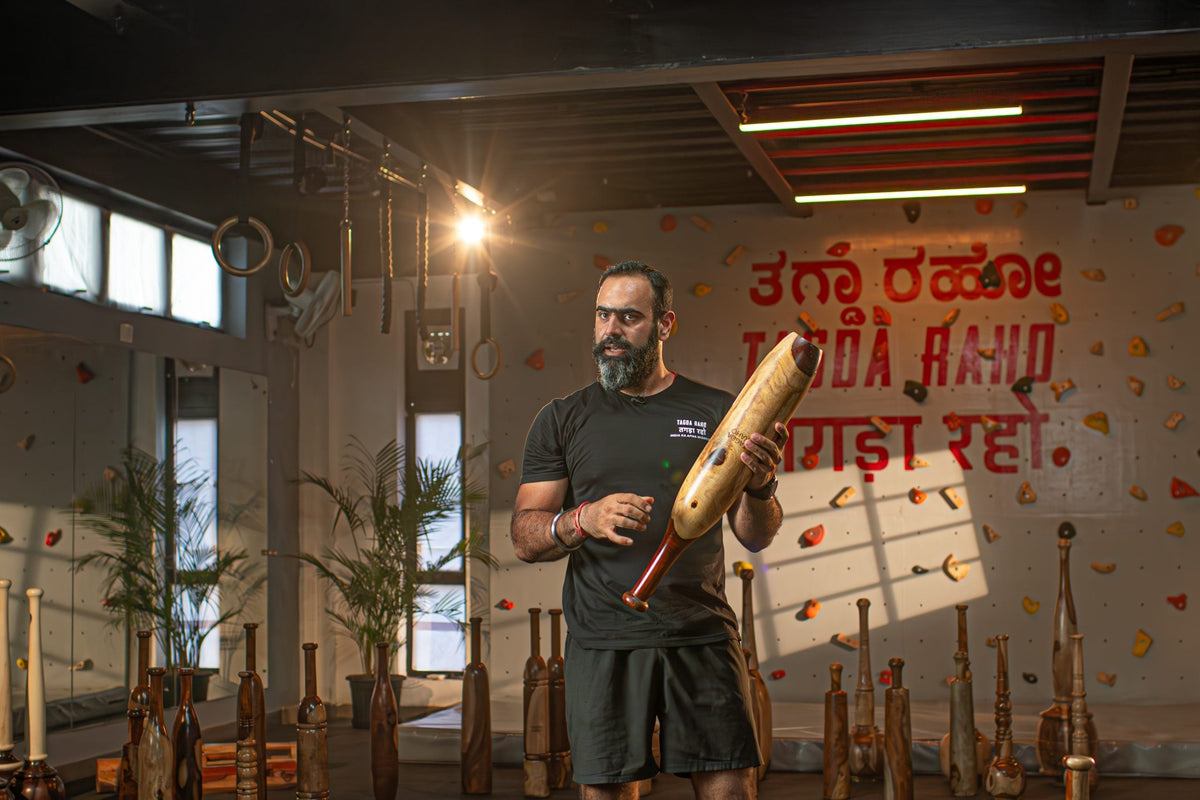
Five names, one shelf, and almost no agreement about what any of them mean.
Search for an Indian club and you will be shown a one pound piece of turned wood. Search for a mudgar and you may be shown the same object, or a seven kilogram club. A gada might be a two kilogram wooden mace or a stone ball on a bamboo pole. Sellers use the words interchangeably. They are not interchangeable.
Here is what each one actually is, how heavy each one actually was, and which to pick up first.
The words
Mudgar comes from Sanskrit mudgara, and the primary sense is not club. Monier-Williams gives a hammer, a mallet, any hammer-like weapon or implement. Apte's dictionary adds a club and a mace as secondary senses, and then, unexpectedly, a kind of dumb-bell. So the oldest meaning of the word is closer to a sledgehammer than to a swinging club, which fits the shape: a heavy head on a short handle.
Gada is the epic mace. In Sanskrit it is feminine, gadā, a mace or club or bludgeon, and it appears throughout the Mahabharata. Bhima and Duryodhana fight the war's final duel with maces in the ninth book, both of them trained by Balarama. Vishnu's mace Kaumodaki appears in iconography from around 200 BCE.
Jori is simply the Hindi word for pair. It is the usual north Indian term for the clubs swung two at a time, and Joseph Alter, the anthropologist who has documented akhara practice for decades, notes that the word itself means pair.
Meel is the one people get wrong most often. It is Persian, not Indian: the implement of the zurkhaneh, the Iranian house of strength. Related tradition, different country, different word.
Samtola, which Alter spells santola, is not a club at all. He glosses it as a wooden bar-bell made from a tree trunk. Weight at both ends, held near the middle.
Nal, while we are here, is a stone weight for lifting, not for swinging.
The oldest one you can go and look at
You will read that these tools are five thousand years old. We could not find a source for that, and nobody who writes it cites one.
What you can actually check is better. In the Mathura Museum, catalogue number GMM 87.145, stands a Yaksha figure known as Mudgarpani, the mudgar holder. It is 1.96 metres tall, dates to roughly 100 BCE, and was found at Bharana Kalan about thirty-two kilometres from Mathura. In his right hand is a mudgar. That is a catalogued, datable, go-and-see-it object about twenty-one centuries old, which is a stronger claim than a round number nobody can source.
The great shrinking
The Indian club sold in the West today is a distant descendant of the Indian original, and it is a small fraction of the weight. How small is documented, and so is how it happened.
The man who commercialised club swinging in America was Sim D. Kehoe, whose The Indian Club Exercise appeared in 1866. The book credits India openly, tracing the exercise from Indian practice into the British Army and on to English gymnasiums. But Kehoe did not get it from India. On a trip through England and Ireland in 1861 he watched Professor Harrison of London swing what the book calls mammoth war-clubs, and on returning home devised a club of his own. The American club arrived through an English intermediary, already reshaped.
His recommended weights are on the page. Clubs are used in pairs, twenty-four to twenty-eight inches long, commonly from four to twenty pounds each. Beginners should start with six to ten pounds. A pair weighing thirty pounds each is rarely used, and he reckoned only one or two men in the country could do more than a few simple movements with them.
The market split quickly. Alter records that as early as 1866 there were already nine types of club for sale, from five to twenty-five pounds for men and one to five pounds for women and children. Donald Walker's Exercises for Ladies had already offered an Indian sceptre of one, one and a half, or two pounds, named for the form of the instrument ladies employ instead of the Indian clubs used by men. Club swinging became an Olympic medal event in 1904 and again in 1932, and never since. A competitor from the 1932 Games remembered the clubs weighing a pound and a half each.
Now the other side of the comparison.
At the Nag Panchami jori competition held at Karnghanta Vyayamshala in Varanasi, the grades run like this: the qualifying level uses clubs of 18 to 22 kg each, then 25 to 27 kg, then 29 to 32 kg, and the top grade starts at 35 kg each. Alter puts the full range at a modest 5 kg per club up to clubs of 70 kg each that are, in his phrase, almost but not quite unswingable. He also records the Banaras Society for Jori and Gada Swinging grading small, medium and large jori at 50, 57 and 73 kg for the pair, which works out at 25 to 36 kg a club. That lines up closely with the Karnghanta grades, from an independent source.
| Club | Weight each |
|---|---|
| Walker's Indian sceptre, for ladies, 1830s | 1 to 2 lb (0.5 to 0.9 kg) |
| Olympic competition club, 1932 | about 1.5 lb (0.7 kg) |
| Kehoe's recommendation for beginners, 1866 | 6 to 10 lb (2.7 to 4.5 kg) |
| Kehoe's heaviest, "rarely used" | 30 lb (13.6 kg) |
| Varanasi jori competition, qualifying grade | 18 to 22 kg (40 to 48 lb) |
| Varanasi jori competition, top grade | 35 kg and up (77 lb and up) |
Do not read the top and bottom of that table as the same sport: the Olympic club was built for speed and pattern, the jori for maximal strength. The fair comparison is the middle against the bottom, since Kehoe and the Karnghanta judges were both describing the heaviest thing a strong man could handle. The lightest club you can qualify with at Karnghanta is heavier than the thirty pound club Kehoe called rarely used.
We should be straight about where our own range sits, because it is not at the Varanasi end either. Our heaviest mudgar is 10 kg, a little over half the lightest club you can qualify with at Karnghanta. That is the right place for almost everybody reading this. It is just not the traditional ceiling, and we are not going to pretend it is.
So what is the actual difference between them
Strip away the names and the difference is where the mass sits relative to your hands.

A mudgar is a shaped club: the mass is in a bulbous head, the handle is short, and it is swung in a circle behind the head, usually as a pair. Alter's description of a typical akhara lists mugdals, gadas and nals side by side, so these were never competing tools. They were a set.
A gada puts the mass at the far end of a long shaft. In the modern akhara Alter describes it as a mace that takes gymnastic form as a large stone ball fixed to a bamboo pole. One heavy end, a long lever, swung one-handed or two-handed. This is the implement whose felt weight has almost nothing to do with the number on the label, which we worked through in a separate piece on why a 4 kg gada is not a 4 kg weight.
A samtola splits the same mass between two ends and you hold it nearer the middle, so the leverage against you is far smaller for the same kilograms. That is why a samtola can be pressed and carried as well as swung, and a gada really cannot.
Which one to start with
If you want shoulder and thoracic range of motion, start with a light mudgar pair. The circular path behind the head is the whole point, and you cannot learn the path while fighting the weight. Two kilograms each is not a beginner's insult, it is the correct entry.
If you want grip and rotational strength, the gada is the specialist. The offset mass is doing the work, so go lighter than your ego wants. Most people should start at 2 to 4 kg regardless of what they can deadlift.
If you want something you can also press and carry, the samtola is the versatile one, and it is the closest thing in the akhara to a barbell.
The mudgar and the gada do not substitute for each other. One trains a path, the other trains a lever. Our own guide to picking a starting weight for each is below.
Two things you will read that we could not support
That Hanuman carries the gada in the Ramayana. Hanuman is the wrestler's god and is shown with a gada in later sculpture and devotional art. In Valmiki's epic he fights with his hands, with boulders, with uprooted trees, and with an iron bar, a parigha, torn from an arched gateway in Lanka. What he does not carry is a gada. The mace belongs to the iconography, not the text.
That the vajra is a traditional club. We sell one, so this is our own name we are correcting. Vajra means thunderbolt, Indra's weapon. The only implement the word attaches to in the tradition is the horn knuckleduster of vajra-mushti, an old wrestling form, and that is a weapon, not a training tool. We found no record of vajra as the name of a swung club. It is a good name for a heavy double-ended mace. It is not a historical one.
Tagda Raho makes and sells the mudgars, gadas and samtolas linked above. Every historical figure here comes from Kehoe's 1866 manual, Joseph Alter's published work on akhara practice, or the published Karnghanta competition grades, all of which you can check.
Share:
Are Hindu Squats Bad for Your Knees?