
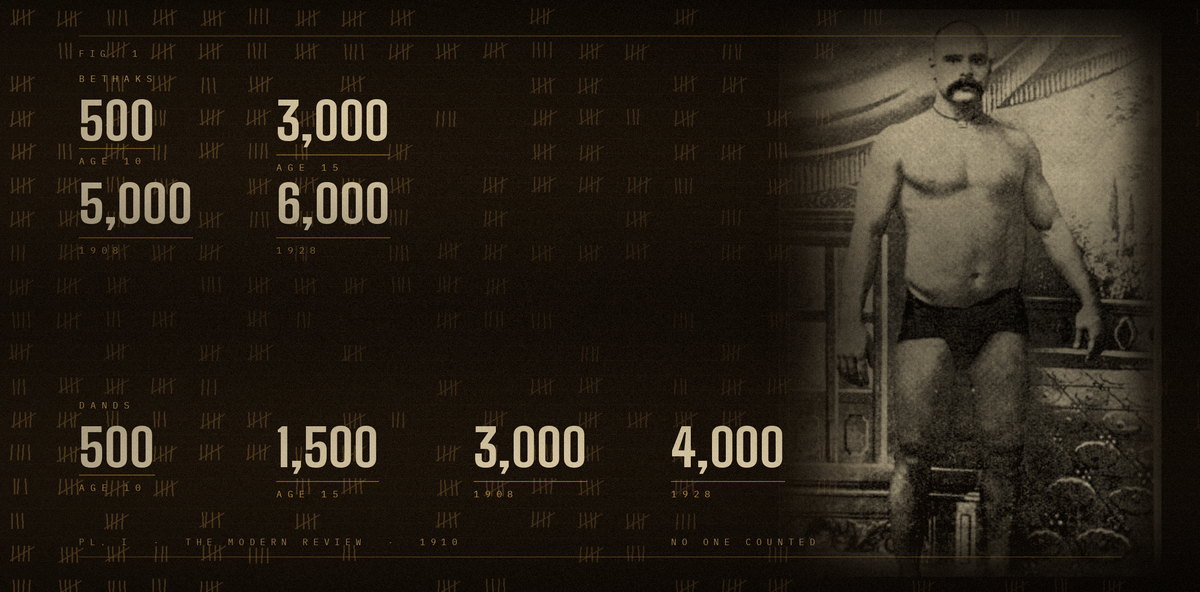
Search for the Great Gama and the same numbers come back every time. Six thousand squats a day. Four thousand push-ups. Twenty litres of milk.
The numbers are real, in the sense that they are what the tradition records. What they are not is a logbook, and the most interesting thing about them only shows up when you read the source properly.
What the account says
The fullest English-language treatment is by Joseph Alter, an anthropologist at the University of Pittsburgh who has spent decades studying North Indian wrestling. His 1995 article in Iron Game History, the physical culture journal at the University of Texas, is an argument about nationalism and the body in colonial India, and Gama's training appears in it as evidence (Alter, Iron Game History, 4(2), 1995). Alter draws on Indian biographers, chiefly Ratan Patodi, Barkat Ali and Dr. S. P. Atreya, who are the people actually doing the counting.
| Age | Bethaks | Dands | Also reported |
|---|---|---|---|
| 10 | 500 | 500 | Milk, almonds, fruit |
| 15+ | 3,000 | 1,500 | Running a mile daily wearing a 120 lb stone ring |
| 30 (1908) | 5,000 | 3,000 | Forty wrestling partners; ten litres of milk, clarified butter, six chickens or the extract of 5 kg of mutton |
| 50 (1928) | 6,000 | 4,000 | Eighty wrestling partners, on essentially the diet he ate at twenty |
A bethak is not a barbell squat. The heels come up, the knees travel forward, the arms swing, and the movement is continuous. A dand sits closer to a dive-bomber push-up than a floor press. Alter glosses them as deep knee-bends and jack-knifing push-ups. Both are unloaded, done in the hundreds, and function as conditioning rather than strength work.
The same numbers turn up elsewhere

A few pages into the same article, Alter describes the regimen of a different wrestler, Sadik: fifteen hundred dands, three thousand bethaks, wrestling practice with twenty compatriots, three miles of running, three hundred lifting repetitions with a heavy santola, and digging the wrestling pit twice with a pharsa.
Fifteen hundred and three thousand. The identical figures given for Gama at fifteen.
Round numbers repeating across different men in different decades are not measurements. They are a convention, the way a tradition states that somebody trained to the full standard. Every count in the table lands on a clean multiple of five hundred, which is not how bodies work and is exactly how oral records work.
Dr. Atreya, the biographer who wrote specifically about Gama's training, made the point himself. Alter reports him as more reserved than the others, on the grounds that nobody could know how many bethaks or dands Gama did daily, because nobody ever watched him start a session and stayed to see him finish. Atreya's conclusion is not that the numbers are inflated. It is that regardless of how many he did, what mattered was that he always did them properly.
That is a different and better idea than the one the internet took from him.
What the numbers do tell you
Put a clock on the age-fifty figure and it becomes concrete. Bethaks are done fast, but nobody sprints for hours. Assume 20 to 30 a minute and 6,000 takes between three hours twenty and five hours. Assume 15 to 20 a minute for dands and 4,000 adds another three hours twenty to four and a half. Those cadences are our estimate rather than anything from the record, but on any reasonable assumption you are looking at roughly seven to nine and a half hours of calisthenics, before wrestling eighty people.
Whether the true figure was 6,000 or 3,000, the shape of the claim is the same: training was the entire day, every day, for forty years. Gama could do that because he was paid to. His father was a court wrestler who took him to the gymnasium of Rajah Bhawani Singh of Datiya as a boy. He later held court positions at Rewa and Orcha, and after 1910 drew a stipend of 250 rupees a month from the Maharajah of Patiala. Wrestling was the job, not the thing fitted around one.
How the loading actually worked
Here is where the akhara record is genuinely specific, and where it contradicts the way these tools are usually sold today.
The bodyweight volume was the base. The loading came from objects, and the objects were heavy. A hundred pound grindstone. A 120 pound stone ring worn for a mile. A santola, which Alter glosses as a wooden bar-bell made from a tree trunk, lifted for three hundred repetitions. A pharsa for digging the pit, which Alter notes can weigh twenty or thirty kilograms. Alter's description of a typical akhara lists an earthen pit, a hard floor for exercises, mugdals (Alter's spelling of the club sold today as the mudgar), gadas and nals for lifting, often a climbing rope and a mallakhamb.
No barbell, no percentages, no deload weeks. But nobody was being precious about load either. The mudgars and gadas in that list sat alongside stone weights and tree trunks, and the reported rep counts for implement work run into the hundreds. High volume and real weight, both.
Which is worth holding onto if you train with these tools now. The tradition does not support swinging something trivial forever, and it does not support occasional heroic singles either. It supports frequent, high-repetition work with something that genuinely loads you, then going up.
A note on the record itself
Two things in the Gama literature are worth flagging, because they show how quickly figures harden.
Alter gives Gama as 5 feet 8 inches and 14 stone, about 196 pounds, at the 1910 London weigh-in, on Barkat Ali's authority. An editor's note appended to the article points out that David P. Willoughby, in The Super Athletes, put him at 5 feet 7 and between 220 and 250 pounds in adulthood. Those may not even conflict, one being a competition weight and the other a career range, but they get quoted interchangeably.
The story that Gama was disqualified from the 1910 London tournament for not being a heavyweight comes from Barkat Ali as well, and Alter notes that the historian Robert W. Smith expressed some doubt about it. What is not in dispute is what followed: Gama issued open challenges, met Stanislaus Zbyszko on 10 December 1910 in a bout called at dusk with no result, and was declared world champion by default when Zbyszko did not appear the next day. When they met again in 1928 it took him forty-two seconds. Alter has him a champion from 1910 until he retired in the early 1940s.
None of this diminishes the man. It just means the honest version of his training is a description of a way of life rather than a set of reps to chase, and that the people who preserved it, Patodi and Barkat Ali and Atreya, deserve their names on it.
One question the record cannot answer is whether doing bethaks in those numbers is good or bad for a knee. We went through what the research actually says, and what it never studied, in a separate piece on hindu squats and knee health.
Share:
A 4 kg Gada Is Not a 4 kg Weight
Are Hindu Squats Bad for Your Knees?