
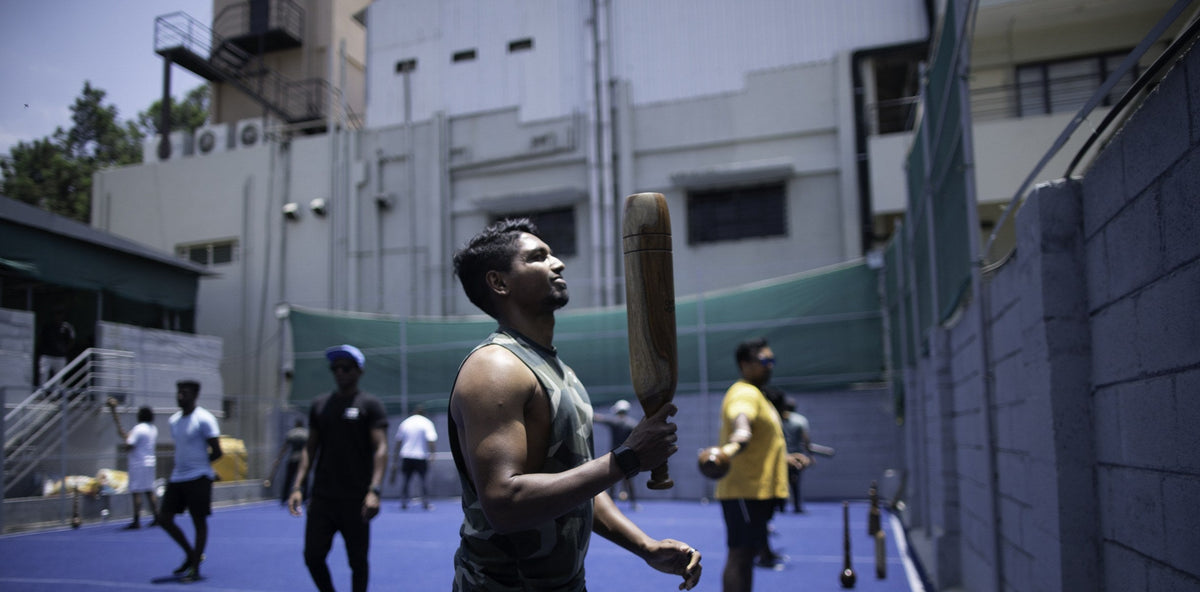
Every company in this category, ours included, says some version of the same thing: swinging a club or a mace is good for your shoulders.
Until recently nobody had measured it. Now three controlled trials have. Here is what they found, what they did not find, and the part that should make everyone selling these tools uncomfortable.
The strength finding is real
This is the best-supported claim in the category, and it holds across three trials, three sports and both sexes.
In Akaras et al. (2026), 27 elite wrestlers were randomized to add mace work or carry on. Twelve weeks, three sessions a week, fifteen minutes each, at 20 percent of bodyweight. All four isometric rotator cuff strength measures improved more in the mace group, internal and external, both arms, every interaction at p of 0.007 or better.
In Walter, Daneshfar and Petersen (2023), 15 female handball players were split between eight weeks of oak clubbell work at 500 g rising to 1 kg and handball training alone. In the seven who swung, all four rotator strength measures improved, between 12 and 22 percent.
In the cricket study by the same group, 21 fast bowlers were split between six weeks of the same clubbells and cricket training alone. Internal rotator strength rose in both arms, 2.5 percent a week in the bowling arm and 2.2 in the other, while the controls lost a little in both.
Three caveats worth carrying. The trials enrolled 63 people between them, but only 31 actually swung anything: 13 wrestlers, 7 handball players, 11 bowlers. None had an active comparator, so swinging was never tested against a band or a dumbbell doing equivalent work, which matters because a mace does not load the shoulder the way its label suggests. And only the cricket paper says plainly that it cannot separate the implement from the simple fact of adding the better part of an hour a week of loaded shoulder work. The other two do not raise the problem at all.
What did not move
The nulls get left out of the marketing, so here they are.
Range of motion barely budged in the clubbell trials. In handball there was no significant between-group range of motion difference on any measure, and only one of four reached significance even within the group. In cricket the results table puts external rotation range at p = 0.08 and 0.07. That paper's own abstract claims bilateral external rotation improvement at p below 0.001, a figure its results table does not support. We have gone with the table. The cricket trial did significantly improve horizontal adduction range in both arms, which is the posterior shoulder tightness measure the authors themselves care about, so this section is not a clean sweep.
Mace training did not change joint position sense. In the wrestling trial every proprioception interaction was null. The discussion claims proprioceptive benefits in one place and concedes in another that mace work "may not provide the specific neurosensory stimulus required" for it. The only significant results there were group differences showing higher error in the mace group, which usually means the groups differed to begin with.
Mobility did not move when it was measured properly. An acute study put seven people through eight minutes of Indian club swinging and measured shoulder flexion, abduction, internal rotation, external rotation and extension with a goniometer afterwards. No significant change in any of them (Phillips and Rothstein, 2024). The much-quoted "35 percent flexibility increase" comes from a 2015 conference abstract that used a combined left and right reach test after two sessions. It reports a significant group by time interaction but publishes no test statistic for it, and the outcome measure has no established validity.
The part that should make us uncomfortable
No club or mace study we could find has recorded a single injury as an outcome, and none has run injury surveillance. The cricket trial notes only that none of its bowlers reported shoulder pain. Three of the five required a clean shoulder or upper limb for the previous twelve months, so the people most likely to show a problem were kept out by design.
So "bulletproofs your shoulders" is not an overstatement of the evidence. It is a claim about something nobody has looked at. The handball paper is the clearest case: it concludes that clubbells could reduce shoulder injury risk, in a study that measured no injuries.
It gets more awkward. The headline shoulder results in the two clubbell trials are internal rotation. The reason anyone cares about internal rotation is the idea that losing it, a deficit known as GIRD, predicts shoulder injury in overhead athletes.
That idea is in trouble.
| Study | Sample | Did internal rotation deficit predict injury? |
|---|---|---|
| Wilk et al., 2011 | 122 pitchers, 170 pitcher-seasons | No (p = 0.17) |
| Wilk et al., 2015 | 296 pitchers, 8 seasons | No |
| Pozzi et al., 2020 | Review of 15 studies | Not pooled at all |
| Strama et al., 2024 | 60 college athletes | No |
Pozzi is a systematic review and overlaps the Wilk cohorts, so these rows are not independent samples.
The one rotation measure with repeated prospective support runs the other way. Having too little external rotation on the throwing side was associated with 2.2 times the injury risk and 4 times the surgery risk in the largest pitcher cohort, and pooled at an odds ratio of 1.90, confidence interval 1.24 to 2.92, in three studies of professional baseball pitchers (Pozzi et al., 2020).
External rotation range is exactly what did not move in either clubbell trial. Strength and range are different things here: the handball players gained up to 22 percent of external rotator strength, which does not address a range of motion risk factor.
The wrestling mace trial is the honorable exception, and on the measure that matters. External rotator flexibility on the dominant side improved, interaction p below 0.001, while internal rotator flexibility did not. That is the single most promising result in this literature, and it is one dominant-side measure in one trial of 13 men.
The bar is lower than you think
The obvious response is that clubs should be held to the standard of a real shoulder prevention program. So it is worth knowing how that standard is doing.
The best-known trial put 660 elite handball players through a five-exercise shoulder program three times a week for a season. It cut the odds of reporting any shoulder problem by 28 percent, an odds ratio of 0.72 with a confidence interval from 0.52 to 0.98. In raw terms that was 17 percent against 23 percent. It did not significantly reduce moderate or severe problems: odds ratio 0.78, interval 0.53 to 1.16 (Andersson et al., 2017).
When three handball prevention trials covering 747 players were pooled in 2025, the combined result was not significant: odds ratio 0.73, interval 0.45 to 1.17, graded low certainty. Removing one trial from the pool flipped it to significant at 0.58, interval 0.35 to 0.97, which tells you how fragile the estimate is in either direction. The authors' own words are that the review did not demonstrate the effectiveness of these programs (Yonneau et al., 2025).
So the honest comparison is not a proven program against an unproven implement. It is a fragile program against an entirely untested one.
What we think you should take from this
The strength gains are probably real and probably not special. Three trials found them. None shows the implement is the reason rather than the loaded shoulder work. If you want the dose the trials actually used, we wrote up how to fit that into a week that already has lifting. In rotator cuff pain more broadly, specific exercise modes beat general exercise only modestly and inconsistently, and the most recent review concludes they show no obvious advantage over general exercise or conventional physiotherapy.
The most defensible positive claim is the smallest one. Eight minutes of club swinging raised peak torque in one diagonal movement pattern immediately afterwards, at p = 0.050 and p = 0.043, with no change in isokinetic internal or external rotation. The authors suggested it as an upper-body warm-up. That is a modest, directly tested claim from a seven-person pilot, and it is more than most of this category can say. Worth knowing that across 31 randomized trials of upper-body warm-up, not one measured injury at all. No upper-body warm-up has been tested for injury prevention, let alone shown to deliver it.
If your shoulder already hurts, nobody has studied you. We could not find a single study of a club or a mace in anyone with impingement, a cuff tear or instability. That is the largest gap between what has been tested and how these tools get sold. Clinical guidelines for rotator cuff problems give their strongest recommendation to an active exercise program, which may include resistance training across a range of loads, so none of this is a reason to avoid loading a shoulder. It is a reason to get the loading from someone who can examine you, and to treat a mace as something you progress back to.
Our own product pages overstate this. The mudgar page says swings are "used by athletes, desk workers, and even physical therapists to restore shoulder mobility, posture, and joint integrity." Strength is supported. Mobility is weakly supported, in one measure, in people who were not tight to begin with. Joint integrity is not supported by anything. We are fixing that copy.
Tagda Raho makes and sells the mudgars and gadas this article is about, so read it knowing we had every commercial reason to write a more flattering version. This is general information, not medical advice. If you have shoulder pain, see a clinician before adding overhead loaded swinging.
Share:
The Wood in a Mudgar: What Sheesham Actually Is