
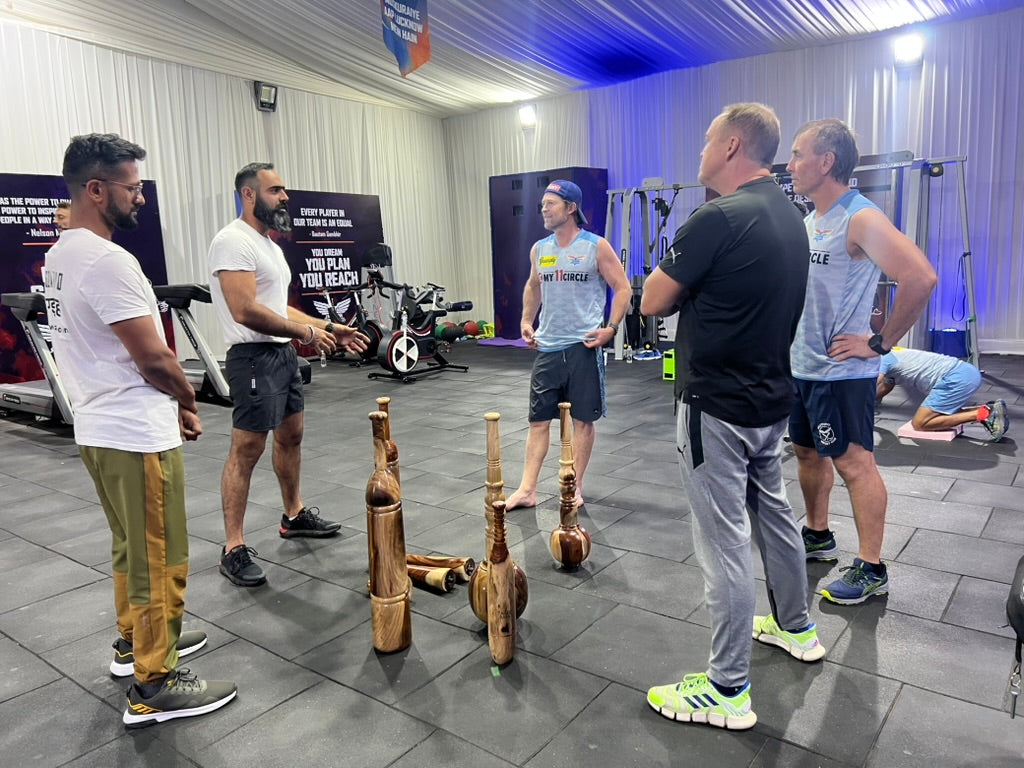
Introduction
When most people think of strength training, barbells, dumbbells, and machines come to mind. But the future of functional fitness lies in movement that trains the body in multiple planes, with balance, grip, and coordination all at once.
Traditional tools like maces, Indian clubs, and gadas are resurging not just as cultural artifacts, but as scientifically valid ways to improve grip strength, shoulder mobility, and whole-body performance.
In this article, we explore what research says about functional strength and mobility, and how tools like maces and clubs can make your training more effective and resilient.
The Scientific Basis for Functional Training
Grip Strength and Upper Extremity Function
Research shows that grip strength is more than a measure of hand power. It correlates with broader upper-body strength and shoulder function. Studies demonstrate that enhancing handgrip strength activates neural pathways that improve shoulder movement control, which can help reduce shoulder pain and improve motor coordination.
Another research article indicates that grip strength reliably reflects upper extremity function and can be used to monitor muscle activation and shoulder rotator strength during training or rehabilitation.
These findings show that grip strength is not isolated to the hands but connected to broader functional movement and joint integrity.
Why Dynamic Tools Outperform Traditional Isolated Training
Rotational and Circular Motion Training
Traditional weight training often works in linear paths. In contrast, mace training and club swinging introduce rotational strength and movement across multiple planes, from frontal to transverse, forward to backward. This mirrors real life and sport more closely than straight pushes or pulls.
According to fitness experts, exercises like mace overhead swings, figure-eights, and rotational drills enhance grip strength, shoulder stability, and rotational torque, areas where standard exercises may fall short.
Continuous Mobility and Strength Integration
Dynamic tools aren’t just about strength. They build fluid mobility at the same time by engaging muscles through a full range of motion. This can improve balance, tendon resilience, and joint lubrication, especially in the shoulders and wrists.
One training perspective highlights that club swinging and mace work train hands, wrists, forearms, and shoulders not only for strength, but for resilience and capability in real-world movement patterns.
Functional Training Benefits for Everyday Movements
Here’s how mace and club based training improve functional performance:
Grip and Forearm Strength
As shown by research on grip mechanics, strengthening the grip enhances upper extremity stability and shoulder control during movement. Tools requiring active gripping under dynamic loads (like maces) are superior for this because they force continuous stabilization.
Stronger grip isn’t just for lifting more; it’s essential for everyday tasks like carrying objects, pulling doors open, or maintaining balance when stepping off surfaces.
Shoulder Mobility and Joint Function
Studies emphasize the importance of active range of motion for shoulder health and performance. Strength programs that integrate circular patterns, such as overhead mace swings, help lubricate the joint and improve active movement, rather than passive stretching alone.
Core Stability and Coordination
Mace work engages the entire kinetic chain. Rotational swings and multi-plane movements recruit the core, hips, back, and legs, creating better neuromuscular coordination than isolated lifts. This is useful for athletes and non-athletes alike, especially those who want strength that works outside the gym.
Putting It Into Practice: A Functional Strength Routine
Here’s a practical routine you can use with maces or weighted clubs to build functional strength and mobility:
Warm-Up (3 minutes)
-
Light club or mace halos
-
Pendulum swings
-
Wrist and shoulder openers
Main Set (10 minutes)
-
Mace 360s | 3 × 8-10 reps per side
-
Figure-8 swings | 2 × 12-15 reps
-
Overhead + hip hinge combo | 3 × 6-8 reps
-
Slow controlled mace holds at end range (front and overhead) | 2 × 30–45 sec
Cool-Down (2 minutes)
-
Wrist mobility drills
-
Deep breathing with light club oscillations
This routine trains grip, shoulder stability, core engagement, and dynamic mobility, all in one go.
Why Tagda Raho USA Functional Tools Are Effective
-
Designed for rotational and dynamic movement, not just linear lifts
-
Builds grip strength, wrist stability, shoulder mobility, and core control simultaneously
-
Scalable for beginners through advanced athletes
-
Adds variety to traditional strength training for better long-term progression
Whether you’re a functional fitness enthusiast, athlete, or someone looking to stay active and mobile for life, mace and club training adds dimension that machines and barbells alone cannot.
Conclusion
Strength is not just a number on a barbell. Real strength combines grip, coordination, mobility, and control. Research shows that hand and shoulder function are deeply connected, and training that integrates rotational motion improves both.
By embracing tools like maces and Indian clubs, you’re not only building muscle. You’re building movement quality that carries into everything you do.
With Tagda Raho USA’s functional fitness tools, you can enhance strength, resilience, and mobility in ways modern machines rarely address.
Stay Strong. Stay Functional. Stay Tagda.
Share:
The Recovery Gap: Why Mobility Is the Most Overlooked Part of Strength Training
A 4 kg Gada Is Not a 4 kg Weight